How AI Is Changing Careers ? (And How to Future Proof your Career ?)
Every day, our feeds are flooded with headlines about the latest Large Language Model (LLM) or automation tool. It is easy to feel like we are all racing against a machine that is getting faster by the second.
But after spending time analyzing the trajectory of this technology, I believe we are asking the wrong question. The question isn’t “Will AI take my job?” The real question is: “How do I partner with AI to elevate my career?” We are not witnessing a replacement of human workers; we are witnessing a redefinition of the nature of work itself.
Here is how AI is fundamentally changing careers—and how to position yourself to thrive in this new landscape.
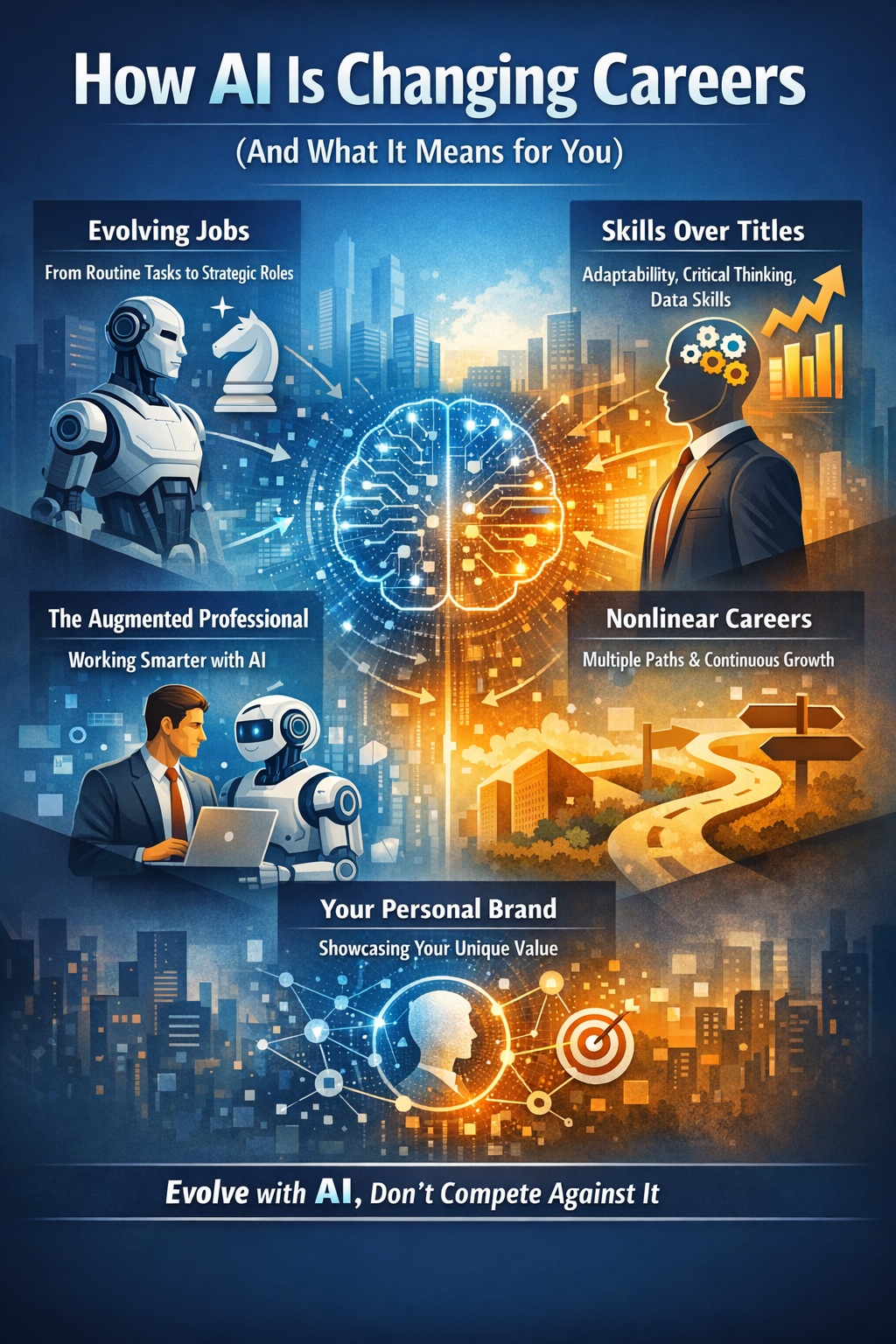
1. Jobs Are Evolving
There’s a common fear that AI will replace jobs.
The reality is more nuanced.
AI is not eliminating work — it is transforming how work gets done.
Tasks that are repetitive, predictable, and rules-based are increasingly automated. But this creates space for something more valuable:
- Strategic thinking
- Creativity
- Relationship-building
- Decision-making under uncertainty
The question is no longer “Will AI take my job?”
It is “How will my role evolve because of AI?
2. Skills Are Becoming More Important Than Titles
In the past, careers were defined by job titles and years of experience.
Today, value is defined by skills — especially those that complement AI.
Soft Skills Are Becoming “Power Skills”
Skills that were once considered “soft” are now the defining factors of career resilience:
Increasingly in demand:
- Critical thinking :
- AI can give you an answer, but it cannot tell you if that answer is right or ethical. The ability to spot hallucinations, bias, and logical fallacies is the new digital literacy.
- Emotional Intelligence (EQ):
- AI cannot navigate office politics, soothe an upset client, or build a high-trust team. As transactional tasks get automated, the value of human connection increases exponentially.
- Adaptability
- The half-life of technical skills is shrinking. The professionals who will win are not those who master one tool, but those who are comfortable picking up a new tool every six months.
Your ability to work alongside AI is becoming more important than your ability to compete with it.
3. The Rise of the “Augmented Professional”
AI is dismantling silos. In the past, you were either a writer, a coder, or a data analyst. Today, these lines are blurring.
We are seeing the emergence of the “Centaurs”—professionals who know exactly when to use human intuition and when to leverage machine speed.
- A Product Manager can now run SQL queries using natural language, reducing dependency on data engineering teams.
- A Marketer can now prototype a landing page in Webflow using AI copilots, bridging the gap between creative and development.
- A recruiter who uses AI to screen smarter, not just faster
- A leader who uses AI to make better decisions
The highest salaries are no longer going to the narrow specialist who can do one thing exceptionally well. They are going to the professional who has a deep domain expertise plus the ability to leverage AI to expand their range of skills.
These are not replaced professionals.
They are augmented professionals — and they are pulling ahead.
4. Career Paths Are Becoming Less Linear
AI is accelerating change across industries.
As a result:
- Roles are evolving faster
- New roles are emerging
- Old pathways are becoming less relevant
This means careers will no longer follow a straight ladder.
AI tools are also lowering the barrier to entry for entrepreneurship and side projects.
In the past, launching a SaaS product required a co-founder who was a developer. Now, one person with a subscription to ChatGPT, Replit, and Canva can launch a minimum viable product in a weekend.
This is changing how we view career security. Instead of clinging to a rigid job description, professionals are building “portfolio careers”—combining consulting, digital products, and full-time employment. AI acts as the administrative assistant that makes this multitasking feasible.
Instead, they will look more like a portfolio:
- Multiple skills
- Cross-functional experience
- Continuous reinvention
5. Your Personal Brand Matters More Than Ever
In an AI-driven world, one thing becomes even more valuable: clarity of value.
AI can process information.
But it cannot replace how clearly you communicate your unique strengths, perspective, and impact.
Those who stand out will be those who can answer:
- What do I do well?
- What problems do I solve?
- Why should someone choose me?
Positioning is no longer optional. It is essential.
How to Future-Proof Your Career
If you are feeling the pressure of this shift, here is a three-step approach to recalibrate:
- Audit your tasks, not your title.
- Look at your weekly to-do list. Identify the tasks that are “pattern recognition” (email drafting, data sorting, basic coding).
- These are the tasks to offload to AI. Double down on the tasks that require “judgment” (strategy, stakeholder management, creative ideation).
- Learn to speak “Machine.”
- You don’t necessarily need to learn Python, but you do need to learn prompt engineering.
- Understanding how to structure a query, provide context, and iterate on output is the new essential skill.
- Build a Personal AI Advisory Board.
- Don’t just use AI for work. Use it for your career.
- Ask ChatGPT to review your resume, role-play a difficult salary negotiation with you, or analyze your industry trends to identify where you should upskill next.
Final Thought
AI is not just changing careers. It is changing how we think about work, value, and relevance.
We are in the early innings of this shift. AI is not a tsunami that will wash away the workforce; it is a tide that is raising the floor of what is possible.
The future will not belong to those who know the most. The jobs of the future will belong to those who view AI not as a threat, but as a co-pilot. The goal isn’t to be faster than the machine; the goal is to be smarter than the machine—to use it to handle the mundane so you can focus on the magnificent.
It will belong to those who:
- Learn continuously
- Adapt quickly
- And position themselves clearly
The shift is already happening.
The only question is: Are you evolving with it?
What about you? How are you using AI to change the way you work? Let’s discuss in the comments. 👇
#ArtificialIntelligence #FutureOfWork #CareerDevelopment #AI #Leadership #DigitalTransformation